
TLDR: The Quick Answer
For most professional environments, the rule of thumb is approximately one hour of cleaning per 1,000 square feet for general maintenance. However, at BD365, we implement a minimum of 2 hours per night, 5 nights per week for our office cleaning contracts. This ensures we aren’t just “skimming the surface” but actually maintaining a hygienic environment. Total time is calculated based on staff numbers (usually 25+), the physical size of the site, and specific operational constraints like security protocols.
When you’re looking at your monthly outgoings, it’s only natural to look at the cleaning bill and wonder: “What are they actually doing for three hours every night?” Or, perhaps more commonly, you’re wondering why your current cleaners are in and out in forty minutes, yet the dust is still piling up on the skirting boards.
Getting the timing right for office cleaning isn’t just about ticking boxes: it’s about finding the “Goldilocks zone” where the office is perfectly clean without you overpaying for idle time. But how do we, as professionals, actually calculate those hours?
Let’s pull back the curtain on how cleaning durations are determined and why “quick” isn’t always “cost-effective.”
The BD365 Standard: Why 2 Hours is Our Baseline
One of the most frequent questions we get is why we insist on a minimum of two hours per night, five nights a week. It might seem like a lot if you have a smaller studio, but there’s a method to the madness.
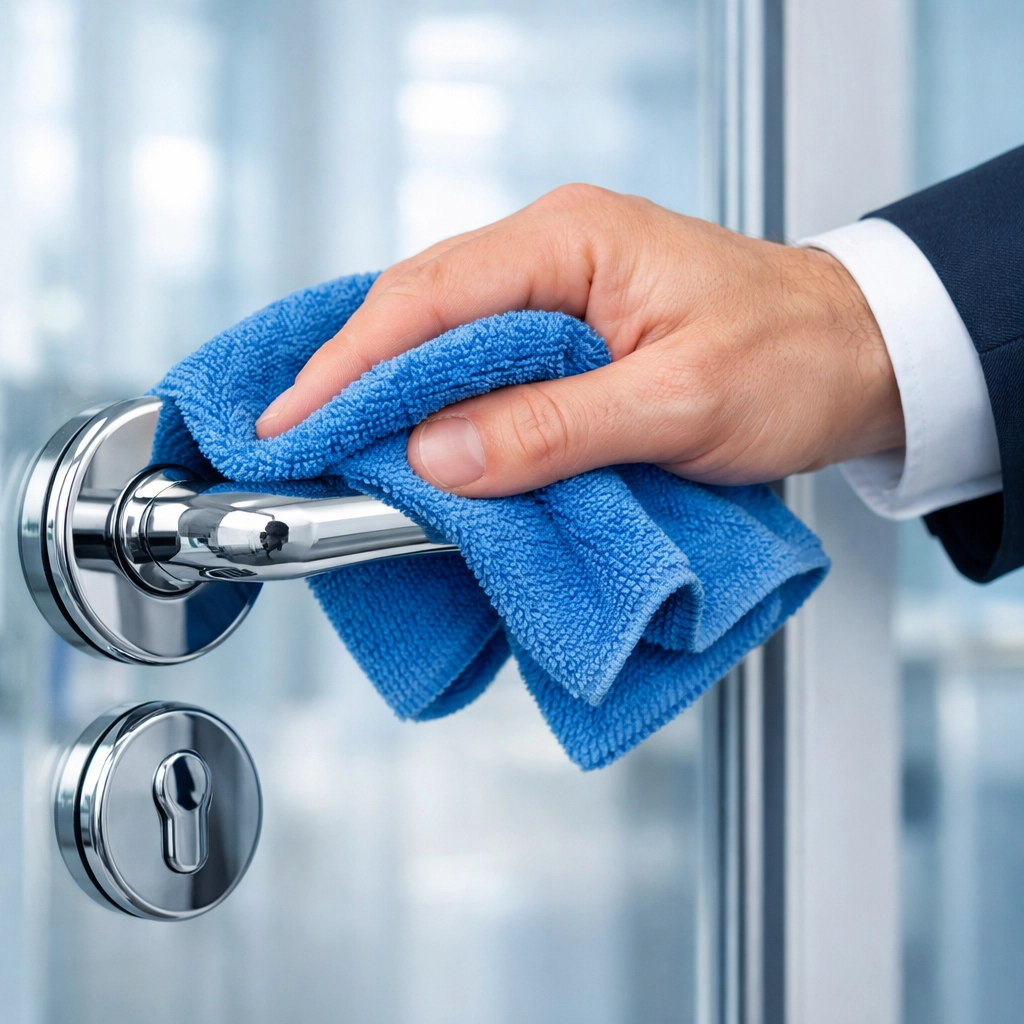
Think about it: by the time a cleaner arrives, secures the building, sets up their equipment, works through a comprehensive checklist, and سپس locks up, a significant chunk of time has already passed. If you try to squeeze cleaning services for offices into a one-hour slot, something has to give. Usually, that “something” is the detail work: the light switches, the tops of monitors, or the proper sanitisation of door handles.
We believe in doing the job right. A 10-hour weekly minimum (2 hours x 5 nights) allows our team to maintain a consistent standard that prevents the “slow creep” of grime that eventually leads to needing an expensive deep clean.
It’s a Numbers Game: Staff Density vs. Square Footage
Most people assume cleaning time is calculated solely on square footage. While the size of the floor plate is a huge factor, the number of people using that space is often more important.
The “25+ Staff” Threshold
In our experience, once an office hits a headcount of 25 or more, the cleaning requirements shift significantly. Why? Because 25 people create a predictable level of “human impact.”
- Restrooms: 25 people using the facilities throughout the day means more than just a quick wipe-down is needed; it requires full sanitisation and restocking.
- Kitchenettes: 25 coffee rounds, 25 lunches, and 25 sets of crumbs. The communal areas in a 25+ person office are high-traffic zones that demand focused attention.
- Touch Points: More people means more fingerprints on glass partitions and more germs on shared surfaces. This is where products like Zoono Microbe Shield become essential for long-term protection.
If you have 50 people in a 2,000 sq. ft. space, it will take much longer to clean than 10 people in that same 2,000 sq. ft. space.
The Breakdown: Where the Minutes Go
Industry standards give us a baseline, but let’s look at how that hour-per-1,000-sq-ft usually breaks down in a real-world office environment:
1. Floors (10-20 Minutes per 1,000 sq. ft.)
Vacuuming isn’t just about the visible bits of paper; it’s about removing allergens and grit that wear down your carpets. If you have hard floors, mopping adds time for drying and repositioning safety signs. For those with high-traffic carpets, we often suggest a periodic professional carpet cleaning to supplement the nightly vacuuming.
2. Restrooms (15-20 Minutes per room)
This isn’t just about the toilets. It’s the mirrors, the sinks, the splashbacks, and ensuring the toilet roll and hand towels are fully stocked.
3. Desks and Surfaces (15-20 Minutes per 1,000 sq. ft.)
This is where the “clutter factor” comes in. A “clear desk policy” is a cleaner’s best friend. If our team has to move piles of paper and personal items to wipe a desk, the time per desk doubles.
4. Kitchens and Breakrooms (20-30 Minutes)
Depending on the level of “office etiquette,” this can be the most variable part of the night. Cleaning microwaves, wiping down centrefeed rolls, and sanitising handles takes precision.
Operational Constraints: The Hidden Time-Thieves
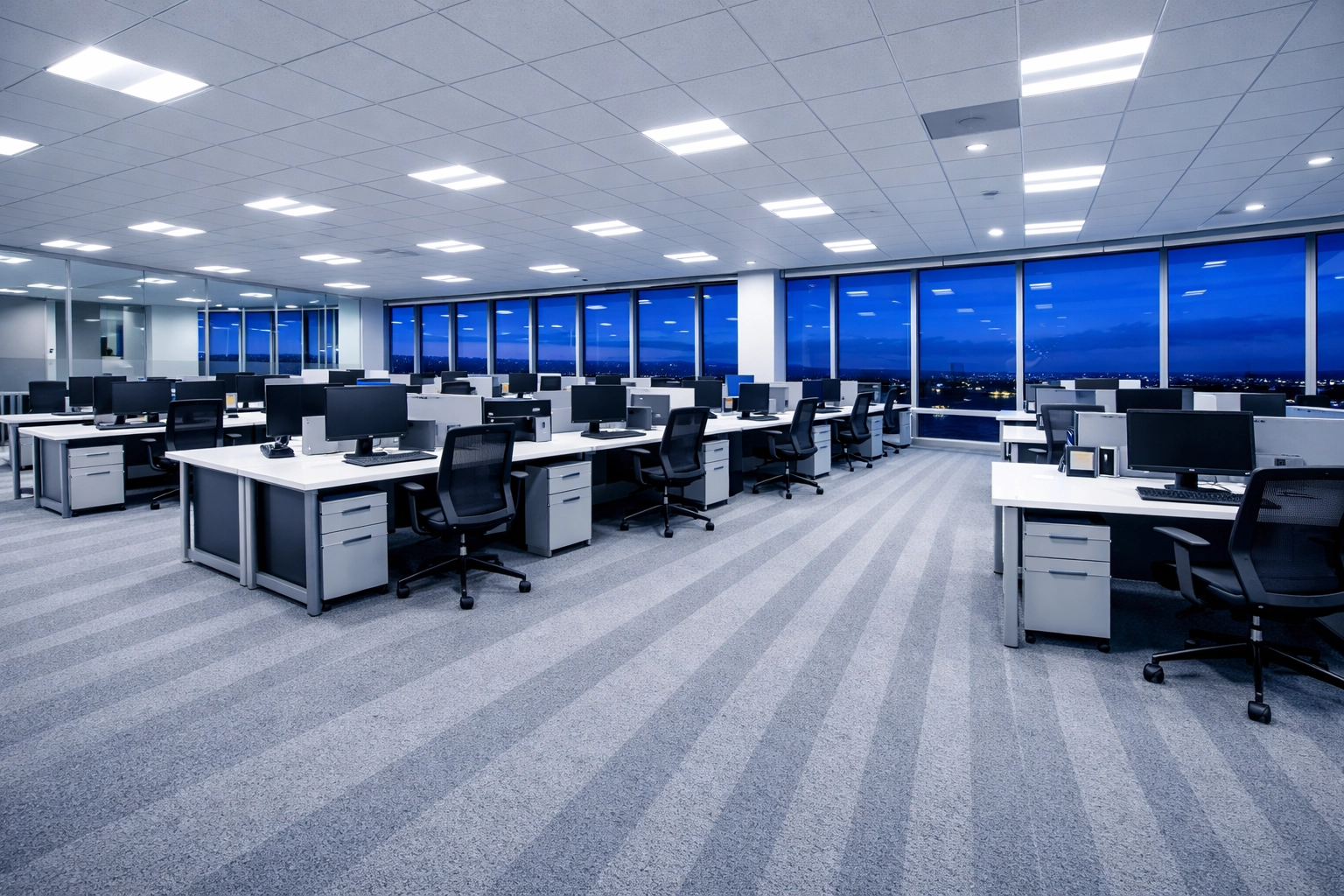
When we provide a quote for office cleaning, we also look at the logistics of your specific site. Not all 5,000 sq. ft. offices are created equal.
- Security Protocols: Does the cleaner need to deactivate three different alarms and sign in at a gatehouse? If a cleaner spends 15 minutes just getting into the building, that has to be factored into the shift.
- Verticality: Is the office spread over three floors with no lift? Moving heavy vacuum cleaners and bulk cleaning supplies between levels takes time and physical effort.
- Waste Management: Does the waste have to be carried to a skip at the other end of a car park? In a large facility, simply “taking the bins out” can be a 20-minute task in itself.
Why Night Cleaning is More Efficient
You might wonder why we specify “every night.” Cleaning in an empty office is significantly faster: and therefore cheaper for you: than cleaning around staff.
When the building is empty, we don’t have to wait for someone to finish a phone call before vacuuming their area. We don’t have to dodge people in the corridors or wait for a stall to become free in the restroom. Night cleaning allows for a “flow” that is 20-30% more efficient than daytime janitorial work. Plus, it means your team walks into a fresh, citrus-scented environment every morning, which is a massive boost for morale.
Can You Speed Up the Process?
If you’re looking to keep your cleaning hours (and costs) optimized, there are a few things you can do to help the process along:
- Declutter: Encourage staff to keep desks clear.
- Centralise Waste: Using central recycling points instead of individual bins at every desk can shave 15 minutes off a shift.
- Provide On-Site Storage: Having a dedicated cupboard for heavy-duty cleaners and equipment means the cleaner doesn’t waste time lugging kit back and forth from a vehicle.

The Bottom Line
At BD365 Facilities Management and Commercial Cleaning Solutions, we don’t believe in “guesstimating.” We look at your square footage, your staff count, and your specific layout to create a schedule that actually works.
If you’re being told that your 40-person office can be cleaned to a high standard in 45 minutes, you’re likely being sold a “surface clean” that will leave you frustrated in the long run. Quality cleaning services for offices require a realistic time commitment.
Ready for a cleaning schedule that actually reflects the needs of your business?
Whether you need a standard contract or something more bespoke like film production cleaning, we’re here to help.
Summary of Factors Influencing Cleaning Time:
- Total Square Footage: The primary baseline (approx. 1hr per 1,000 sq. ft.).
- Staff Count: Offices with 25+ staff require more intensive sanitisation.
- The BD365 Minimum: 2 hours per night, 5 nights per week to guarantee quality.
- Layout: Open plan is faster than many small partitioned offices.
- Task List: Deep cleaning tasks like glass and stainless steel polishing add time.
- Access: Security and logistical hurdles can add 10-20% to the total duration.
Don’t settle for a “quick” clean when you can have a BD365 clean. Contact us today to discuss a tailored plan for your workspace.